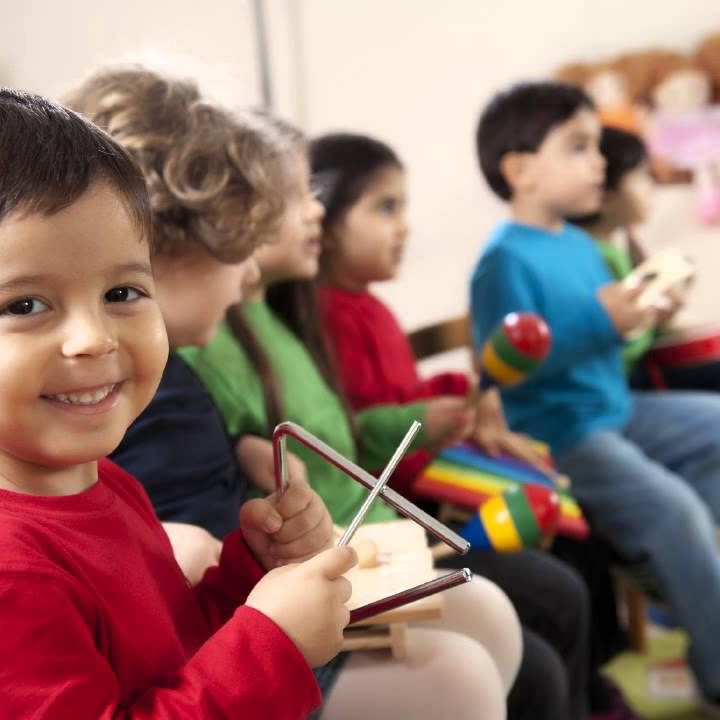
Benefits of Music Education
Introduction
What are the benefits to children of an Early Childhood Music Education?
On this page we will explore firstly, the specific benefits of our unique Early Childhood Music Education products in learning music in a fun, natural and intuitive way.
Secondly, we will explore the overall benefits to children of an Early Childhood Music Education.
Studies show the brains of children with musical training develop faster. We hope to show that music education benefits the young child in many ways, not just musically.
Benefits of Miss Mon's Music Education Products
General Benefits
- Products are based on a traditional song repertoire, to lay a strong musical foundation.
- Products are themed according to the Kindergarten/Preschool Curriculum.
- We offer a wide variety of song styles and genres.
- We offer a choice of Single Song Products, Single Song Packs and Theme Packs
- Products are available at a low cost to make music education affordable for your child.
- Online products allow for easy accessibility to music education, which is available 24 hours a day, 7 days a week.
- Products are designed, performed and created by a music teacher who tailors every detail to the specific needs of young children in early childhood.
- Products are created by a singer who has performed live and composed their own music and music workshops for children. This experience adds a real world approach to music education.
- Each song is recorded in a key and at a tempo best suitable for young children.
- Product recordings use live instruments on all songs to add the human touch
Product Benefits
- We provide a vocal melody mp3 to sing along with and learn the song
- We provide an instrumental backing track with an instrumental melody, as an aid to learning the song
- We provide a backing track without any melody to sing along with once the song is learnt.
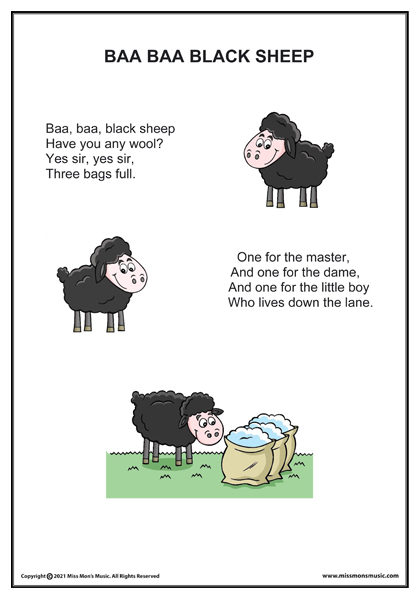
- We provide a lyric sheet with every product
- We provide sheet music of the song's arrangement, in the same key as the vocal recording.
- We provide a coloured poster of the song to stimulate the imagination
- We provide a colouring-in sheet of the song as an added bonus activity

FREE PRODUCT
To view and download a FREE sample of one of our products, click on the links below:-
- Audio Single Song - Baa Baa Black Sheep Single Song
- Audio Single Song Pack - Baa Baa Black Sheep Single Song Pack

Benefits of Early Childhood Music Education

Brain Development
Modern Brain Research is revealing how neural connections in the brain are activated and strengthened through active music participation. This is especially true in early childhood when the brain is rapidly developing.
Eric Jensen states that music is ‘part of our built-in, biological design’, and plays a role in developing essential neurobiological systems (“Arts With The Brain In Mind” 2001, p13 ASCD USA )

Problem Solving
Music activities support cognitive skills that help children organize
their thinking and behaviour. Music helps children solve problems, sort things out and achieve goals.
Research has shown that musicians have higher levels of grey matter volume in their brains, which are directly tied to auditory processing and comprehension. This means that music training can help children with their ability to process situations and find solutions mentally.

Listening
Learning music involves connecting sound to meaning. Sound is made up of pitch, timing and timbre. When children are immersed in music, they are listening to these sensory details, which in turn improves their auditory processing ability.
Research has shown that music helps children with listening skills in all areas of learning, not just music. It looks as though active participation in music education does for the brain, what exercise does for body fitness.

Memory
Songs are learned by using our ears and learning a song takes time, and begins with listening to many repetitions, until it is memorised.
Research shows that the IQ in children improves when they are taught to have larger working memory capacity. Because learning songs and music is increasing a child’s working memory, it is also increasing their ability to think.

Concentration
Learning anything properly involves concentration, focus, patience and practice. In learning music, children are given the opportunity to concentrate and focus through using listening skills. Visual material that accompanies the music, such as books, posters, felt boards, can also help. The ability to concentrate is obviously an important skill that can be strengthened through Music and will translate into other areas of learning.

Sounds, Repetition and Rhyme
Studies show that the area of the brain controlling both musical ability and language comprehension are more intricately linked than previously thought.
Pitch, tone and enunciation of words are recognized and repeated in music education. Music directly benefits young children’s ability to learn words, speak them correctly, and process the many new sounds they hear from others.
Dr Lucy Bainger, in her article “Music and Learning For The Young Child” states the following:-
“Music is a symbol system with its own markings that carry meanings. Developing listening skills and learning to read rhythm symbols and identify syllables are valuable pre-reading skills”.

Beat, Rhythm and Counting
In the same article as above, Dr Lucy says:-
“Music is built on reoccurring beats, which marks out time in equal portions. Rhythms are numerically connected to the beat. Exploring beat and rhythm introduces the young child to mathematical concepts in a simple form”
Activities such as learning number songs, counting down songs, counting sounds, counting beats and creating and recognising patterns, make music an ideal platform for learning mathematics.
Motor Skills and Coordination
To quote Dr Lucy again, from the same article above:-
“For the young child, music and movement are always connected. Learning to move the body using both gross and fine motor skills develops the child’s physical coordination.”
Dancing along to music helps children build their gross motor skills. Gross motor skills are the ones that enable children to move larger muscles, like their arms and legs.
Fingerplay songs can help with fine motor skills. Even a basic introduction to an instrument, such as a hitting a triangle or shaking a tambourine, can be beneficial in developing a child’s fine motor skills, involving hand-eye coordination and dexterity.

Crossing the Midline
Crossing the Midline has become a well-known phrase in Occupational Therapy and Special Education and is a main feature of programs such as Brain Gym.
Imagine a line that starts from the top of your head and draws straight down to the point between your two feet. This figurative line splits your body into left and right halves and is known as the midline. The term ‘crossing the midline’ depicts the movement of a body part over the midline from one side to the other side of the body to complete a task.
Singing and performing simple action songs that require you to cross the midline, fully engage your brain, as both brain hemispheres are communicating well. In other words, doing the traditional song, “Hokey Pokey,” can facilitate and strengthen a child’s neural networks to coordinate movement and learning.
Physical Balance
Music activities can improve a child’s coordination and balance.
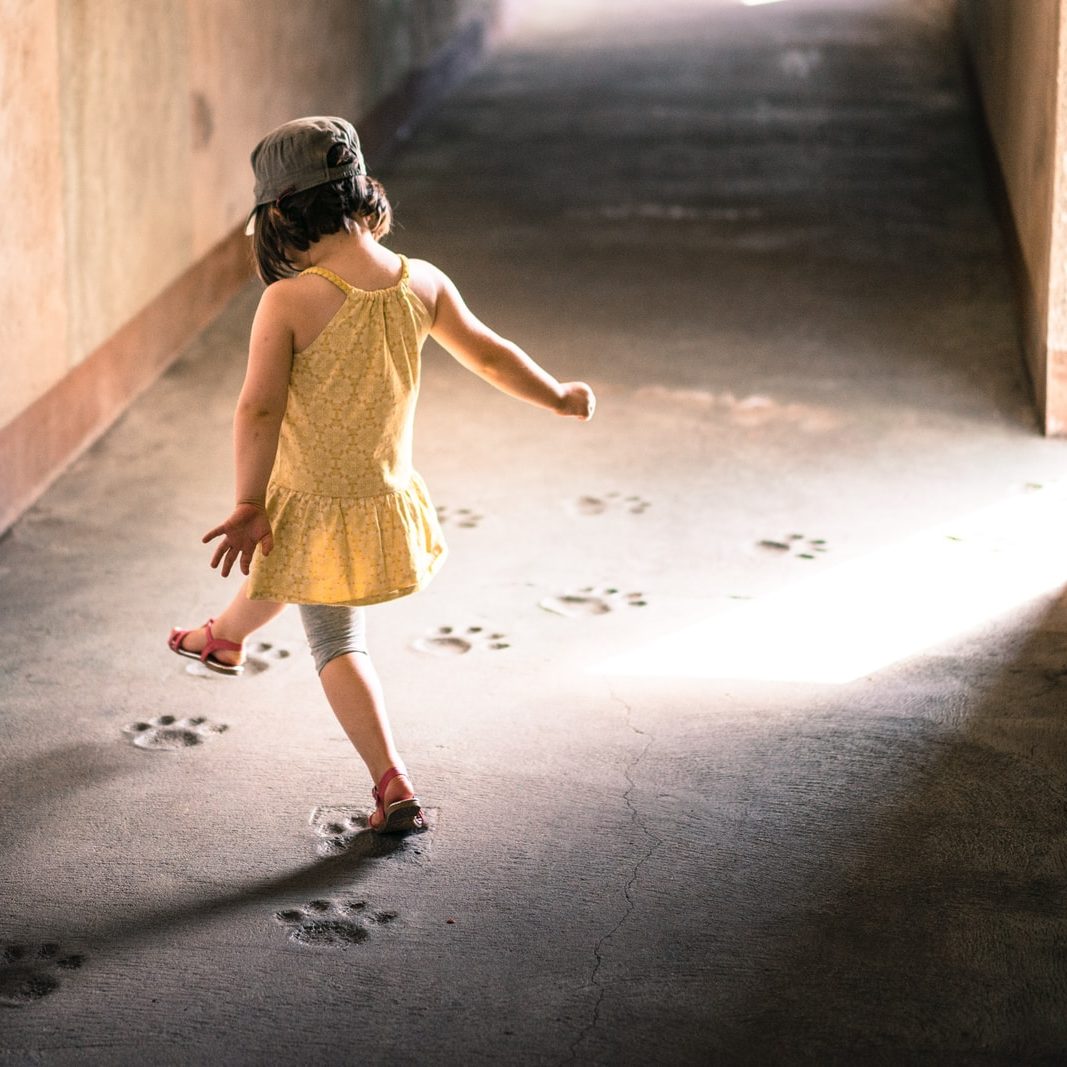
Songs that require children to move and stop help with balance. Action songs involving hopping and jumping can also help with locomotive skills and balance.

Social Skills
Music activities provide opportunities for children to develop socially. Music involves playing games that require social skills, such as the following:
- eye contact
- greeting
- cooperation
- participation
- sharing attention
- turn-taking
- hand holding
- listening to others
- taking a leading role

Emotional Skills
Music activities can also foster a child's emotional development through the following:-
- self regulation
- social competence
- self confidence
- self expression
- behavioral control

The Importance Of Creativity
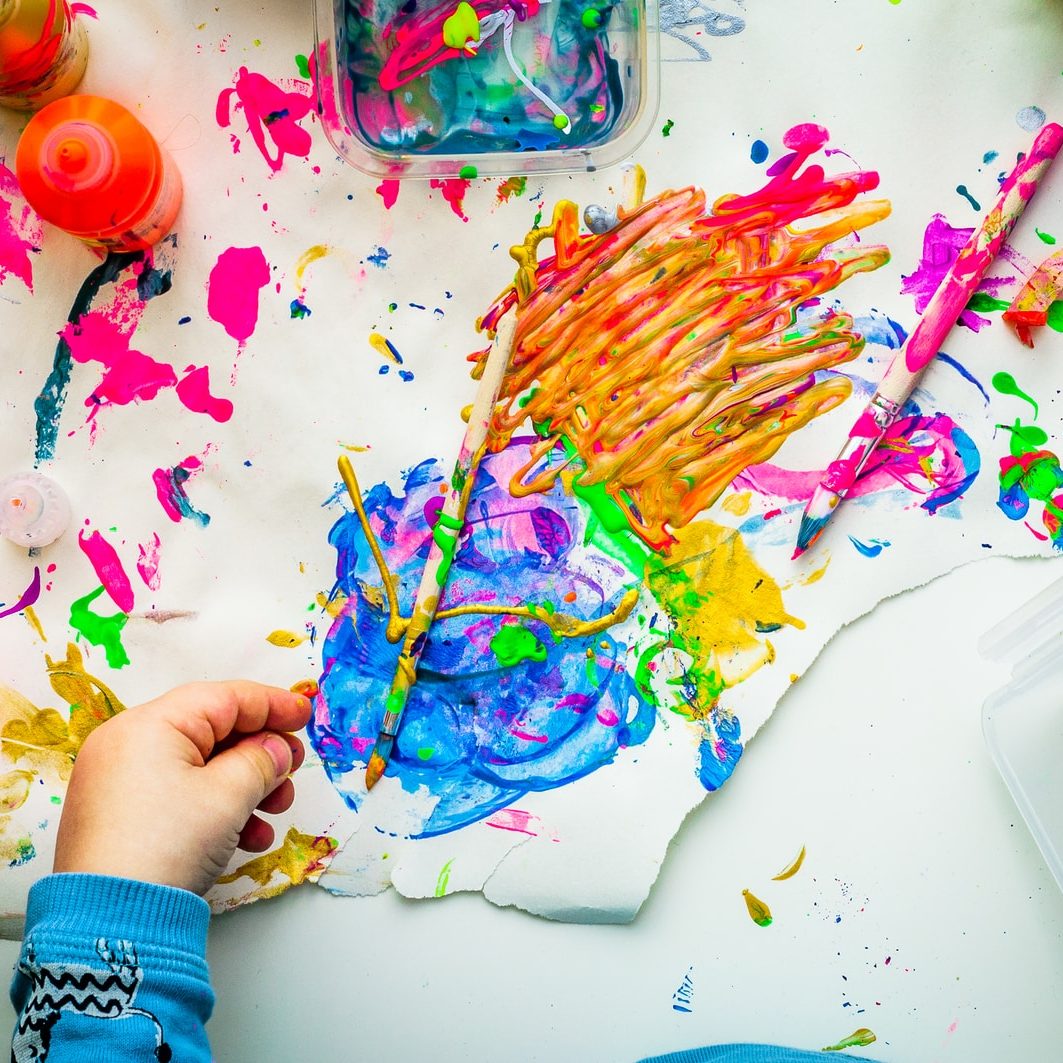
Music activities and playing musical instruments open up a whole world of creativity for the young child. Music provides opportunities for children to create, compose and improvise.
These creative skills are becoming more and more essential in this modern world where change is happening at a rapid rate.
As Neil Moore , creator of "Simply Music" points out, predictive sciences don't give us access or information about how to deal with this rapid change. The ability to respond to unexpected circumstances requires a different outlook. His solution is the use of musical skills, namely, Improvisation, Harmony and Creativity. This is the power of music!
In other words, music teaches us to be creative in life. It helps us with lateral thinking and problem solving skills and teaches us how to harmonize with others. Creative skills give children an entrepreneurial edge, in a world that is increasingly competitive and complex.

Create, Compose and Improvise
Children learn through play and also through repetition and imitation.
Once a song is learnt, the child can be challenged to create something new from what they already know. Even asking children to change one word in a song is teaching them compositional and improvisational skills, at a basic level.
An example would be singing Old MacDonald and asking them to provide the next animal name to sing. Also, the sound that the animal makes can be changed, according to the child's imagination.
Child directed activities, rather than teacher directed activities encourage creativity. An example of this is through questioning:-
eg "What do you think we should do now?"
"How do you think we should play here?
Other examples of using creative skills in music activities include the following:-
- Creating actions to go with a song
- Creating new verses to known songs by substituting words and/or sounds. Also replacing a name in a song with their own name.
- Improvising by playing the beat or rhythm of a song their own way using non - tuned percussion instruments. An example would be choosing their own way of playing a drum by tapping with hands, knuckles, elbows, head, fingers.
- Improvising by playing a pentatonic song on a tuned percussion instrument, such as a xylophone, which is set up by the adult, only using notes from the pentatonic scale of the song. This allows children to improvise successfully and tunefully.